
How an endoscopy works: technology and medical procedure


In many hospitals in Latin America, when a new endoscopy tower is installed or the endoscopy system in the gastroenterology department is upgraded, a common question arises among administrators, biomedical engineers, and clinical staff: how an endoscopy actually works from a technological and clinical perspective.
Although the procedure is part of daily practice for a gastroenterologist, understanding how this technology works is essential for administrative teams or clinical engineering staff when making purchasing, maintenance, and operational decisions.
Endoscopy is a technique that allows visualization of internal structures of the body using advanced optical devices. In modern hospital practice, this technology combines optics, lighting, digital image processing, and therapeutic intervention devices.
Understanding how an endoscopy works not only helps explain the procedure to patients. It also helps explain why the quality of the endoscopy system can directly affect diagnosis, procedural safety, and the operational efficiency of the department.
What an endoscopy is and its clinical objective
To understand how an endoscopy works, it is first necessary to understand what this procedure is.
Endoscopy is a medical technique that uses an instrument called an endoscope to directly observe internal cavities of the body without the need for open surgery.
The endoscope incorporates several technological components:
-
a high-resolution camera
-
a lighting system
-
channels for medical instruments
-
flexible motion control
This allows doctors to observe internal structures such as the esophagus, stomach, colon, or airways.
In clinical practice, endoscopic procedures are used for two main purposes:
Diagnosis
-
lesion detection
-
evaluation of inflammation
-
biopsy collection
Treatment
-
polypectomy
-
bleeding control
-
dilation of digestive structures
For this reason, endoscopy has become an essential tool in gastroenterology, digestive surgery, and pulmonology.
How a digestive endoscopy works in clinical practice
When analyzing how a digestive endoscopy works, it is important to understand that the procedure combines medical technology with specialized clinical technique.
The procedure generally follows these steps:
Patient preparation
Before the procedure, the patient must follow specific instructions such as fasting or bowel preparation, depending on the study.
This step is essential to ensure good visualization during the examination.
Endoscope insertion
The endoscope is inserted through a natural body opening, such as the mouth or rectum.
Thanks to its flexible design, the device can move through the digestive tract, allowing for visual examination of the inner walls.
Real-time visualization
The endoscope camera transmits images to a high-definition medical monitor.
The specialist observes these images while controlling the movement of the instrument to examine the different areas of the organ.
Intervention if necessary
If a lesion or abnormality is detected, the doctor can use instruments introduced through the endoscope to perform therapeutic procedures or take tissue samples.
This approach allows multiple problems to be addressed without the need for open surgery.
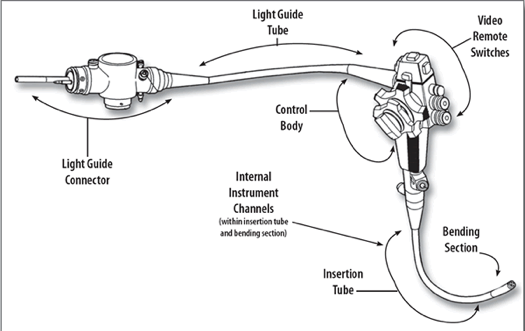
How an endoscope works: main components
Understanding how an endoscope works requires analyzing the technological components that make up the system.
A modern endoscope integrates several systems within a flexible device.
Optical system
The optical system allows images of the inside of the body to be captured.
In current equipment, the image is obtained using digital sensors that transmit the signal to the video processor.
The quality of this system determines image sharpness and the ability to detect small lesions.
Lighting system
The inside of the human body is dark, so the endoscope incorporates a lighting system that allows internal structures to be clearly visualized.
Modern light sources use LED or xenon technology to provide intense, uniform illumination.
Working channels
The endoscope includes internal channels that allow medical instruments such as biopsy forceps, resection loops, or coagulation devices to be introduced.
These channels turn the endoscope into both a diagnostic and therapeutic tool.
Control system
The doctor controls the movement of the endoscope using a control system located on the instrument's handle.
This allows the tip of the device to be directed in different directions inside the organ being examined.
Medical endoscopy technology in modern hospitals
The technology used in endoscopy has evolved significantly in recent years.
Today, endoscopy systems include advanced components such as:
-
high-definition cameras
-
digital image processing
-
electronic contrast enhancement
-
video capture and storage systems
These advances have improved the ability to detect early lesions in the digestive tract.
In hospitals that perform advanced diagnostics, image quality is a determining factor in identifying subtle changes in the digestive mucosa.
How a hospital endoscopy system works
In hospital practice, endoscopy does not depend solely on the endoscope.
The procedure requires a hospital endoscopy system composed of several pieces of equipment that work together.
The main components include:
-
endoscopy tower
-
video processor
-
light source
-
medical monitor
-
image capture system
The endoscopy tower acts as the system's control center.
The processor receives the signal from the endoscope camera, processes it digitally, and sends it to the monitor so the doctor can observe it in real time.
In hospital implementation processes, specialized providers such as GSMED Imaging often participate in the configuration and installation of these systems, ensuring that the components work correctly as an integrated whole.
Common mistakes when evaluating endoscopy technology
From the perspective of clinical engineering and hospital management, there are some common mistakes when evaluating technology for endoscopy departments.
One of the most common is focusing solely on the initial price of the equipment.
However, specialists usually evaluate other equally important factors such as:
-
spare parts availability
-
local technical support
-
accessory compatibility
-
ease of maintenance
An endoscopy system with limited technical support can lead to downtime that directly affects the operation of the department.
Total cost of ownership of an endoscopy system
In hospitals that conduct technology investment analyses, the concept of total cost of ownership is used.
In the case of endoscopy systems, this analysis includes factors such as:
-
initial equipment investment
-
preventive maintenance
-
accessories and consumables
-
staff training
This approach allows for the evaluation of the technology's real impact over time.
What a serious endoscopy technology proposal should include
When hospitals or clinics evaluate endoscopy technology providers, technical proposals usually include several key elements.
Among them:
-
complete system configuration
-
processor and camera specifications
-
included accessories
-
installation and training plan
-
maintenance terms
This type of information allows hospital committees to objectively compare technology alternatives.
A common situation in the implementation of endoscopy departments
In a regional hospital seeking to expand its gastroenterology department, the management team decided to upgrade its endoscopy system.
During the evaluation process, the biomedical committee compared several options available on the market.
The difference between the proposals was not solely the price of the equipment, but factors such as technical support, spare parts availability, and image quality.
Ultimately, the decision was made by considering the overall operation of the system, not just the initial cost.
This type of analysis reflects how understanding how an endoscopy works also involves understanding the technology that supports the procedure.
FAQs
How does an endoscopy work?
An endoscopy works using a device called an endoscope that incorporates a camera, lighting, and channels for medical instruments. The endoscope is introduced into the body through natural openings such as the mouth or rectum. The camera transmits real-time images to a medical monitor, allowing the specialist to observe internal structures and perform diagnoses or therapeutic procedures.
How does a digestive endoscopy work?
In a digestive endoscopy, the doctor introduces a flexible endoscope through the mouth to explore the esophagus, stomach, and duodenum. The device's camera transmits images to the monitor, allowing the observation of the digestive mucosa and the detection of possible lesions, inflammation, or bleeding.
What technology does medical endoscopy use?
Modern endoscopy uses high-resolution digital camera technology, LED or xenon light sources, video processors, and image capture systems. These components allow detailed images of the inside of the body to be obtained to facilitate clinical diagnosis.
What is an endoscope and how does it work?
An endoscope is a flexible medical instrument equipped with a camera and a lighting system. It works by transmitting images from inside the body to an external monitor. It also includes channels that allow medical instruments to be introduced to perform biopsies or treatments.
What parts does an endoscopy system have?
A hospital endoscopy system generally includes a flexible endoscope, an endoscopy tower, a light source, a video processor, a medical monitor, and image capture systems. All these components work together during the procedure.
What is an endoscopy used for?
Endoscopy is used to diagnose diseases of the digestive tract, take biopsies, identify lesions, or perform therapeutic procedures such as polyp removal or gastrointestinal bleeding control.
Does endoscopy require surgery?
No. Endoscopy is a minimally invasive procedure that is performed without open surgery. The endoscope is inserted through natural body openings, which reduces the patient's recovery time.
How long does an endoscopy take?
A digestive endoscopy usually takes between 10 and 20 minutes. However, the total time of the process may be longer due to patient preparation, sedation, and the subsequent recovery period.
Who performs an endoscopy?
Endoscopy is performed by medical specialists, generally gastroenterologists or surgeons trained in endoscopic procedures. Nursing staff and specialized technicians also participate during the procedure.
Where is an endoscopy performed?
Endoscopy is performed in hospitals, clinics, or medical centers that have specialized gastroenterology or digestive endoscopy units, equipped with specific medical technology for this type of procedure.


