
Ecoendoscopy: advanced diagnosis with endoscopic ultrasound


In the gastroenterology services of hospitals and specialized centers, endoscopic ultrasound has become a key tool for the advanced diagnosis of digestive diseases. This technology combines two widely used medical methods: endoscopy and ultrasound.
Unlike conventional endoscopy, which only allows visualization of the inner surface of the digestive tract, endoscopic ultrasound also allows observation of the deeper layers of the organs and nearby structures using ultrasound.
This has significantly expanded diagnostic capabilities for diseases of the pancreas, stomach, esophagus, and bile ducts.
In modern clinical practice, understanding what endoscopic ultrasound is allows us to understand why this technology is increasingly used in hospitals seeking to improve diagnostic accuracy and reduce the need for invasive procedures.
What is endoscopic ultrasound
Endoscopic ultrasound, also known as endoscopic ultrasound or endosonography, is a medical procedure that combines endoscopy with ultrasound technology.
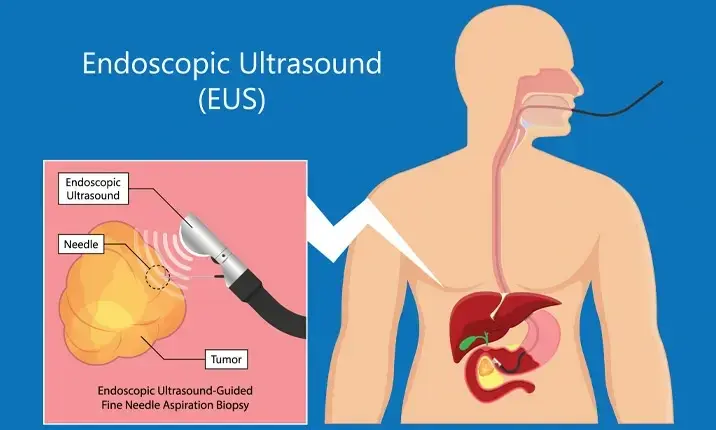
The procedure uses a special endoscope that incorporates an ultrasound transducer at its tip. This allows images to be obtained both from the inside of the digestive tract and of the surrounding tissues and organs.
During the procedure, the endoscopic ultrasound probe is generally introduced through the mouth or rectum, depending on the area to be studied.
The images obtained using ultrasound allow for the evaluation of internal structures that cannot be observed using conventional endoscopy.
This combination of technologies makes endoscopic ultrasound a highly precise diagnostic tool in medical practice.
How endoscopic ultrasound works
To understand how endoscopic ultrasound works, it is important to understand the principle of medical ultrasound.
Ultrasound uses high-frequency sound waves that are transmitted through the body's tissues. These waves bounce off different internal structures and return to the transducer, generating images that can be viewed on a monitor.
In endoscopic ultrasound, the ultrasound transducer is located at the tip of the endoscope.
This allows the specialist to obtain images from a position very close to the organs being studied, which significantly improves image resolution.
Thanks to this proximity, endoscopic ultrasound can detect small lesions that might go unnoticed in other imaging studies.
What endoscopic ultrasound is used for
Endoscopic ultrasound has multiple clinical applications in digestive diagnosis.
Among the most important are:
-
diagnosis of pancreatic tumors
-
evaluation of lesions in the esophagus and stomach
-
study of submucosal tumors
-
evaluation of lymph nodes near the digestive tract
-
diagnosis of biliary diseases
In addition to diagnosis, endoscopic ultrasound can also be used to perform therapeutic procedures or to obtain tissue samples through ultrasound-guided biopsies.
Digestive endoscopic ultrasound in pancreatic diagnosis
One of the most relevant applications of digestive endoscopic ultrasound is the study of the pancreas.
The pancreas is an organ that can be difficult to evaluate using other imaging methods due to its deep location within the abdomen.
Endoscopic ultrasound allows detailed images of this organ to be obtained and small lesions or structural changes to be detected.
For this reason, endoscopic ultrasound is frequently used when pancreatic tumors or pancreatic cysts are suspected.
Endoscopic ultrasound-guided biopsies
An important advantage of endoscopic ultrasound is that it allows guided biopsies to be performed with great precision.
During the procedure, the specialist can introduce a needle through the endoscope to obtain tissue samples from suspicious areas.
This procedure is known as endoscopic ultrasound-guided fine-needle aspiration.
The obtained samples are sent to the laboratory for pathological analysis, which allows diagnoses to be confirmed more precisely.
Technology used in endoscopic ultrasound
The systems used for endoscopic ultrasound include specialized equipment that integrates endoscopy and ultrasound.
Among the most important components are:
-
endoscopic ultrasound probes with ultrasound transducers
-
image processors
-
ultrasound systems
-
high-resolution medical monitors
These systems require precise technological integration to ensure high-quality images.
In many hospitals in the region, specialized providers such as GSMED Imaging participate in the implementation of advanced endoscopic systems used in gastroenterology and digestive diagnosis.
Common errors when implementing endoscopic ultrasound technology
From a hospital perspective, the implementation of endoscopic ultrasound requires considering several technical factors.
One of the most frequent errors is underestimating the importance of specialized training for medical staff.
Endoscopic ultrasound is a procedure that requires specific training in both endoscopy and ultrasound image interpretation.
Another important aspect is the proper selection of the technological system and available technical support.
The availability of specialized maintenance can directly influence the continuity of the service.
Total cost of ownership of endoscopic ultrasound systems
When hospitals evaluate incorporating endoscopic ultrasound technology, they usually consider the total cost of ownership of the system.
This analysis includes factors such as:
-
initial equipment investment
-
preventive maintenance
-
accessories and consumables
-
staff training
Evaluating these aspects allows for more informed decisions about the implementation of advanced medical technology.
A common case in pancreatic diagnosis
In a hospital that treated patients with suspected pancreatic diseases, specialists observed that many diagnoses required multiple imaging studies before confirming the pathology.
The implementation of endoscopic ultrasound allowed for significantly improved diagnostic accuracy in these cases.
Thanks to the combination of endoscopy and ultrasound, specialists were able to identify small pancreatic lesions and perform guided biopsies during the same procedure.
This type of technology has transformed the way various digestive diseases are diagnosed in modern medicine.


